.comment-link {margin-left:.6em;}

Tossing Pebbles in the Stream

This blog is my place to sit and toss pebbles into the stream. The stream of Life relentlessly passing before us. We can affect it little. For the most part I just watch it passing and follow the flow. Occasionally, I need to comment on its passing, tossing a pebble at it to enjoy the ripple affect upon Life's surface.

Monday, November 16, 2009

In Memoriam


David LaChapelle 1923-2009

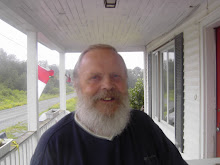
My friend and tenant, David, died today. His body decided it was time his Spirit join the stream of memory of the ages. He lived with several ailments but his systems just slowly shut down.


David taking a rest from helping me do the firewood in 2008

David came to live with me when he asked his new wife, my friend June, if I might consider them moving in with me. He wanted one more time to live on a farm in the country in a house. I am pleased that I managed to adjust my life enough to accomadate him and June. The only real adjustment was giving up my library for him to use; it being on the ground floor. There was an irony in this as Dave was illiterate, like so many of the rural French Canadian men of his generation. I tried to interest him in a couple of books with wonderful pictures and he showed no interest. His life had been that of a doer and not a thinker.

I think David enjoyed the few years he live with me. He shared his room with his two little dogs and always took an interest in the few livestock animals I had, particularly the pigs. He was forever watching them and expressing concern for things they may be doing.

He and June had been neighbours in a "geared to income" garden apartment. June came to look after him. He asked her to marry him. It came to be an arrangement that was beneficial to both. I had the pleasure of performing the wedding at my farm down my the cabin on the river.

David had been married to his first wife for over 60 years. They had 10 children. (not uncommon for a French Canadian country couples of his generation)

David was an oldtimer who lived around here all his life. He was born in Crystal Falls, downstream from here on the Sturgeon River. Briefly, he even lived and worked here in River Valley. He worked in the Bush, the mills, trucking, wherever the work was. He also had a farm property in Verner, Ontario, south of here, upon which he raised and fed his family.

I enjoyed David's company. He was quite quiet and seemed to like wrestling on the TV more than anything else. He was always interesting to me when he spoke of the old days and what life was like a couple of generations ago. I was an eager listener, being a bit of a local history buff.

I shall miss him. I hate to see elders like him leave us, for they always have more to teach us.

For a man, who only ever knew work taking care of his family , he is now at rest and peace.


So live, that when thy summons comes to join
The innumerable caravan, which moves
To that mysterious realm, where each shall take
His chamber in the silent halls of death,
Thou go not, like the quarry-slave at night,
Scourged to his dungeon, but, sustained and soothed
By an unfaltering trust, approach thy grave
Like one who wraps the drapery of his couch
About him, and lies down to pleasant dreams.

(Last verse of Thanatopsis, William Cullen Bryant)


Posted by Picasa

Sunday, November 15, 2009

Santa Claus Parade

Today is the Santa Claus Parade in Toronto. Christmas is coming! I am not ready.

The Toronto Santa Claus Parade is the oldest and largest Christmas parade in the world. It is 105 years old this year. It is a Toronto institution. My parents watched it as children, my siblings and I have memories of standing in crowds, or sitting on the curb watching the parade and waiting for the final float with Santa himself on board; and, for the few years I lived near Toronto after returning from the US, my son got to watch the parade alongside his cousins. I hope my grandchildren have seen it in person. If not, it is not too late. I wrote a long blog entry a couple of years ago on this. You can find it here.


Santa in the 1957 Santa Claus Parade. It is from the later part of my era of me watching the parade.

For 77 years, the T. Eaton Company sponsored the parade, which they founded. It terminated at their large department store where Santa entered though a second story window to take up his place on his thone in Eaton's Toyland. How we loved our yearly visit to this wonderous place full of toys.

Eaton's was a major institution in Toronto dominating retailing there and across Canada though their mail order business. People in remote rural communities could buy almost anything through the catalogue. In Toronto, at one time, you could even order your groceries and have them delivered by Eatons. Eaton's vans were a familiar sight on the streets around Toronto as they delivered orders made over the phone. Sadly Eatons is no more. It failed to adapted and did not survive the changing retail scene. In Toronto, the Eatons Centre is a monument to what was.
The Santa Claus Parade now has many sponsors and executive of companies can even be celebrity clowns for a fee. I wonder if it is more commercial now than what I remember? I believe it is still largely a volunteer organization that puts it all together and makes it a success.

Here you can go and look through the 1909-1910 Fall and Winter Eaton's Catalogue. By clicking on the page, it turns over. You can also zoom it to enlarge the images. I have it open at the toy section. I am surprised at how many of the toys are still popular today, nearly 100 years later. The prices are also a shock. In the section of wood burning cook stove you could buy a lovely one for $35. I have been offered $3,000 for my antique stove.

The government of Ontario has an archive of the Parade covering the many year of its existence.
It is interesting to view. There are even short clips of the parades past to view.

It has been years since I was at the Santa Claus Parade. I live too far away. It is best watched with children. It would be interesting to view it now and see the crowd. Canada is now so much more ethnically and culturally diverse now compared to when I was a child and even since I moved away when my son was a child. I wonder how many of the newcomers have gotten in the spirit of the Parade and how the parade has changed due to the new demographic. The parade has always been a secular event. Religous communities do not participate, to my knowledge, ecept for the Salvation Army and the YMCA. All groups should be able to participate in the parade as well as the watching of it.
Must go. The parade is about to start of TV. I hope this is the beginning of the Christmas season for some. (Delayed for Americans because of Thanksgiving. :) )

Wednesday, November 11, 2009


Postscript in Memory


This video by Donald Brittain and the National Film Board, made in 1965, is very informative and touching as it visits the sites of significant battles in which Canadians participated in WWI and WWII. Well worth the time to view it.


Remembrance Day


When I was young I was encouraged to learn and remember the sacrifices of war, through the iconic poem, In Flander's Field by Canadian John McCrae who served as a surgeon in the First World War. He was a remarkable person both as a soldier and a doctor. This poem which was required to submit to memory by students of my generation. McCrae died in the Great War trying to save the lives of fellow soldiers of all countries, allies and enemies alike.
He is buried in Europe. His poem was written after he had a close friend die in the second battle of Ypres in Belgium.

It was in the imfamous horrifying battles of Ypres, Passchendaele and the Somme, that the soldiers of the Canadian Expeditionary Forces, fought and died and forged a reputation for themselves and Canada for getting the job done. In particular, The Battle of Vimy Ridge is seen as a major step on Canada eventually becoming a well respected sovereign Nation in much the same way as the Battle of Gallipoli forged a national consciousness for Australia and New Zealand. These battles, some of which were defeats, had significance well beyond a battle in a war. The sacrifices by citizen soldier help forge a Nation., our Nation, Canada.


In Flanders Fields

In Flanders fields the poppies blow
Between the crosses, row on row,
That mark our place; and in the sky
The larks, still bravely singing, fly
Scarce heard amid the guns below.
We are the dead. Short days ago
We lived, felt dawn, saw sunset glow,
Loved, and were loved, and now we lie
In Flanders fields.

Take up our quarrel with the foe:
To you from failing hands we throw
The torch; be yours to hold it high.
If ye break faith with us who die
We shall not sleep, though poppies grow
In Flanders fields.
— Lt.-Col. John McCrae (1872 - 1918)

It was so long ago that the World suffered the Great War, the war to end all wars. While we have for generations promised not to forget, the world has gone to war time and time again, including WWII. Why can we not heed the veterans admonition , "Never Again". We have failed them and must once again redouble our efforts to make war no longer an option in settling political disputes.

The Great War was during such a different life and times. The images of it are not fresh in our minds. They are startling as to how different it was. I have spent a lot of time looking at pictures, photographs and paintings. They are quite revealing. There are many sites you can access to view them. Canada's military archives are a source of so much interesting information. There are others. I encourage you to search them out and refresh you memories. With the veterans of the first war virtually all gone, there is no one left with direct memories of those times past. We need to study so we will remember still.

I post the picture below of downtown Toronto on Armistice Day 1918. What a wonderful day it must have been. The sacrifice was great and the surviving soldiers, many of whom were just farm boys when the left, were coming home much changed by the worst war ever for the common soldier. It was a great adventure for some and a great horror for all.


Toronto, Armistice Day November 11, 1918


We need to do better. We can do better. War is never the answer. It is hard to envison another war in Europe not because of military strength but diplomatic efforts to create a community of Nations committed to prospering together through their interdependence. Such mature efforts are the way Peace will be realized and major wars will be no more.

The World has lost so much human capital in lives cut short in war. WE REMEMBER!

Monday, November 09, 2009

Walls, Walls, Walls


Mr. Gorbachev, Tear Down this wall, ! Tear down that wall, Mr Obama! Tear down that wall! Mr Natanyahu.

Today, they are celebrating the breeching of the wall that separated East and West Germany. Whether the wall is seen as a way of keeping the East Germans in or the West German out, (with all their dangerous capitalist ideas) depends on your point of view. We in the west have been told it was a great good. Freedom and the material bounty of the West would become available for the East Germans. In twenty years it is not as simple as that. Not all East Germans shared in the new found life. The East German sector still lags economically behind the West. And now we here there are those who think life was better for many behind the wall, under the socialist policies of the Communist governments. There was an equality, work, free education, free medical care, security. Perhaps, the baby was thrown out with the bathwater. http://www.commondreams.org/headline/2009/11/08-1

The lesson of today is that walls do not work in the long run. The German wall ultimately could not keep people in or ideas out. We should be questioning if the wall the US is so eager to build between to hold back the tide of Mexicans some feel are a threat to the existence of the Nation. Also, the Israeli wall, enforcing keeping out Palestinians making them prisoners in the West Bank and Gaza.

In this spirit, I share with you this poem by Canadian, Joy Kogawa


Where there's a Wall

where there's a wall

there's a way

around, over, or through

there's a gate

maybe a ladder

a door

a sentinel who

sometimes sleeps

there are secret passwords

you can overhear

there are methods of torture

for extracting clues

to maps of underground passageways

there are zepplins

helicopters, rockets, bombs

bettering rams

armies with trumpets

whose all at once blast

shatters the foundations


where there's a wall

there are words

to whisper by a loose brick

wailing prayers to utter

special codes to tap

birds to carry messages

taped to their feet

there are letters to be written

novels even


on this side of the wall

I am standing staring at the top

lost in the clouds

I hear every sound you make

but cannot see you


I incline in the wrong direction

a voice cries faint as in a dream

from the belly

of the wall

Joy Kogawa

Joy Kogawa knows about "walls". She and her family are Canadians of Japanese ancestry. They were interned during the second world war behind the wall of the the Rocky Montains. This was a mistaken attempt to make all Canadians feel more secure, unless of course you were one of the Japanese-Canadians whose life was uprooted, your property and business taken by the government. This "walling up" of our fellow citizens achieved little other than harm to members of our Society. It was a national shame for which the Canadian govenment finally apologized. Japanese Canadians, shamed us all by quietly putting their lives together after the war and continued to contribute to Canadian society as the loyal citizens they were all along.

Joy Kogama's award winning semi-autobigraphical novel, Obasan, about her families internment has been considered the most important Canadian historical work.


Walls takes many forms. They need not by physical. Dissidents among us are often walled off in various ways for the "protection" of the rest of us. One who knew the sting of this and rose above it was Paul Robeson, the remarkable, singer, actor, ethnologist, socialist, black American. He had his passport taken by the government to limit his free travel abroad. He was seem as a threat to America. He and his ideas were subversive. There were ways around this wall.


Cross that Line

Paul Robeson stood

on the northern border

of the USA

and sang into Canada

where a vast audience

sat on folding chairs

waiting to hear him.


He sang into Canada.

His voice left the USA

when his body was

not allowed to cross

that line.


Remind us again,

brave friend.

What countries may we

sing into?

What lines should we all

be crossing?

What songs travel toward us

from far away

to deepen our days?

Naomi Shihab Nye

We all need to examine the walls that surround us, physical and psycho-social. Do they serve us well and achieve what we think they do. A serious inquiry would show that they do not accomplish much worthwhile. My friend, Lynne, it today visiting the Great Wall of China, the greatest of all walls, and yet it did not keep the Mongolian Hordes out.

Saturday, November 07, 2009

JUST THE TWO OF US

I imagine every parent has some special momento from when their child was young, below is mine.

(click on image to enlarge)


"Daddy and Me"
This is a drawing my son made when he was in nursery school. I remember him bringing it home and giving it to me, obviously excited to please me. And, I was pleased.
I am the one with the beard. (He has never known me otherwise) The little one is looking up at me with pride as if to say, he's my dad. Who could not cherish this gift.
Apparently, he drew it and the teacher asked him who it was. "Daddy and me" ! The teacher then wrote that on the picture. It is in such a damaged condition because one day my son tried to ripe it up when he was mad at me one day. I was not going to part with it. I have kept it all these years (36).
They were good years, actually the best years of my life, because he and I were a small but close family. The pain of divorce has faded over the years but the delight of being the parent of a little fellow remains fresh in a special place in my memory.
Posted by Picasa

Thursday, November 05, 2009

40 SIGNS THAT YOU MAY BE CANADIAN:


I am posting this just for the fun of it. For my American friends it is sharing some of Canadians quirkness: fo Canadian family and friends who have been in the U.S. too long it is a refresher course; for Americans who are considering moving to Canada, study there will be a test at the border; and, for the rest of us. . . .Well, you must recognize yourself by this list.


1. You stand in "line-ups" at the movie, not lines.


2. You're not offended by the term, "Homo Milk"


3. You understand the phrase, "Could you please pass me a serviette,I just spilled my poutine"


4. You eat chocolate bars instead of candy bars.


5. You drink pop, not soda.


6. You know what it means to be on pogey.


7. You know that a mickey and 2-4's mean "Party at the camp, eh!!"


8. You can drink legally while still a 'teen.


9. You talk about the weather with strangers and friends alike.


10. You don't know or care about the fuss with Cuba, it's just a cheap place to travel with good cigars and no Americans.


11. When there is a social problem, you turn to your government to fix it instead of telling them to stay out of it.


12. You're not sure if the leader of your nation has EVER had sex and don't want to know if he has!


13. You get milk in bags as well as cartons and plastic jugs.


14. Pike is a type of fish, not some part of a highway.


15. You drive on a highway, not a freeway.


16. You sit on a couch not a chesterfield - that is some small town in Quebec!


17. You know what a Robertson screwdriver is.


18. You have Canadian Tire money in your kitchen drawers.


19. You know that Thrills are something to chew and "taste like soap".


20. You know that Mounties "don't always look like that"


21. You dismiss all beers under 6% as "for children and the elderly".


22. You know that the Friendly Giant isn't a vegetable product line.


23. You know that Casey and Finnegan are not a Celtic musical group.


24. You participated in "Participaction".


25. You have an Inuit carving by your bedside with the rationale, "What's good enough protection for the Prime Minister is good enough for me".


26. You wonder why there isn't a 5 dollar coin yet.


27. Unlike any international assassin/terrorist/spy in the world, you don't possess a Canadian passport.


28. You use a red pen on your non-Canadian textbooks and fill in the missing 'u's from labor, honor, and color.


29. You know the French equivalents of "free", "prize"and "no sugar added", thanks to your extensive education in bilingual cereal packaging.


30. You are excited whenever an American television show mentions Canada.


31. You make a mental note to talk about it at work the next day.


32. You can do all the hand actions to Sharon, Lois and Bram's "Skin-a-ma-rinky-dinky-doo" opus.


33. You can eat more than one maple sugar candy without feeling nauseous.


34. You were mad when "The Beachcombers" were taken off the air.


35. You know what a toque is.


36. You have some memento of Doug and Bob.


37. You admit Rich Little is Canadian and you're glad Jerry Lewis is not.


38. You know Toronto is not a province.


39. You never miss "Coaches Corner".


40. Back bacon and Kraft Dinner are two of your favourite food groups.


Note: Re: #16 In our house we sat on a chesterfield. We are of British stock.


Funny list, eh!


Sorry! I forgot from where I lifted this list or I would give credit. Forgetfulness seem to be an affliction of people my age. Yes, I did remember to google the title and I still could no locate the source.

Sunday, November 01, 2009

Blaauwildebeestefontein

Have you ever had a word from your past pop into your head? Well I did. It was Blaauwildebeestefontein. I even managed to spell it the first time. Wouldn't it be a lovely word for a game of Trivial Pursuit that focused on literature.

Friend, Donna, you just might know it even if no one else does. It is an imaginary place in your beloved Africa, specifically South Africa.It is a word that I have remembered all these years since studying the novel, Prester John, by John Buchan, in high school.

It was our duty to study this novel because a former Governor General of Canada wrote it from 1935 t0 1940. He died while holding this post. This was back in the day when the Queen's representative was sent from the motherland, Britain. Buchan had been in the foreign service in

South Africa, which is the location of this novel. The choice of the book may not have been on the merits of it as literature but I support the choice since Buchan relished coming to Canada as a challenge to help develop " a distinct Canadian Culture". We really were a cultural wasteland as a colonial outpost of Britain. The Americans were well ahead of us in their literary tradition. I don't know if he had a cultural impact, or not, for it would be 20 years before Canada really began to assert it's own literary tradition. Before WWII it was a different time to the age of my growing up. It was still the age of the British Empire, which is reflected in this book. Well, as usual I have digressed. (One thing about teaching myself to touch type I find I write longer blog entries.) I may need an editor.

My moment of insight did not begin with this wonderful sounding word, which had also impressed the song writer Paul Anka, who at age 15 tried unsuccessfully to write a song using it. In spite of a career in the US this little musical footnote demonstates his Canadian credentiaLs. He is in deed one of us. How different the music for my generation if we had been singing about "Blaauwildebeestefontein" rather that "Diana" as his first great pop song.

Remembering this word got me to thinking (always dangerous) about the fragments of memories from our youth that pop up from time to time and remind us who we are and where we came from. I started making a list.

In high school , besides Prester John, I remember studying Barometer Rising, by Hugh MacLennan, an actual Canadian novelist. Other books I remember fondly are Beautiful Joe, by Margaret Saunders, a Canadian children's novel from the 19th Century, the Anne of Green Gables Stories , by Lucy Maud Mongomery, and of course, several Shakespeare plays. With my parents involved in amateur theatre, I was one the unusual one in my crowd of friends who actually went to the theatre, including seeing a handful of Shakespeare plays. I did have a fovourite children's book, which I gave away years ago to a special young person, and have missed it ever since. It was Gumpy, Son of Spunk, by Arthur C. Bartlett, about a boy and his building of a successful sled dog team. It only seems available now through antique book sellers.

I remember vividly only two American novel. Tom Sawyer and Huckleberry Finn. I came to know these because my mother liked them and read both of them to me at least twice and I read them myself. I wonder if parents still read novels to their children, one chapter, or two, every evening until the tale is told? Danial Boone and Davy Crockett I would learn about on TV. I think m y mother also read me Little Women so I was vaguely aware of the fruits of the "Flowering on New England" which I eventual came to read a lot, since my church denomination was the spiritual side of the Transcendentalism of the New England Enlightenment. (Once again, I digress)

There may be others but these seemed to be the limited literary collection that I enjoyed long ago and still recall from time to time. I was not an extensive reader back then. I learned at my mother's knee as she told me all about what she was reading. ( I was a good listener back then)

We laughed a lot in our home. We had a great collection of largely British skit humour on records that we played time and again until we know large parts of the routines by memory. It got so we could just use a phrase form a skit and we would all laugh remembering the whole thing. I still have some of these records but don't seem to be able to get anyone to sit long enough to listen to them. They include several Peter Sellars records, Beyond the Fringe, The Establishment, Fool Britannia, ( several skits spoofing the Profumo Sex Scandal in the British government.) and Harry Lauder ( the famous music hall entertainer.) My comic influence was clearly British. Knowledge of American humours was unavoidable with the advent of TV.

I recently left a reference in a comment I made on Facebook to Albert and the Lion. It just popped into my head. I can remember it well. I think my mother knew it all by heart. That and the Battle of Hastings were the two British humourous poems of that type we enjoyed repeatedly.

Also, I knew something of the words of Dickens. I am not sure if I read him or just soaked him up in the admosphere of our home. It was a tradition in our house every Christmas to read "A Christmas Carol". by Dickens. I can visualize the book now it was a song book of Carols that had Dickens; story in the back. It sat year round in the piano bench with my sister's sheet music.

Among the table games we played as a family while often listening to the radio broadcasts, we played a lot of Scrabble. My mother was good at it BUT my father was clever in his choice of places to put words. He invariable won to everyone's frustration. We had a little ritual with this game which pops out whenever I might have something in a little bag that will make a sound when shaken. We kept the pieces for Scrabble in a paper back and it was my grandmother who first shook the bag before anyone picked replacement tiles (to be fair). She would announce, "And we will shake the bag." I catch myself saying this occasionally still and smiling. . .remembering.

I grew up with little thrift aphorism that are always with me. "A stitch in time, saves nine." A penny saved is a penny earned." "Take care of your pennies and your pounds will take care of themselves." Less traditional were my mother's admonitions to alway treat girls nicely. I have mentioned these before. I don't know why they were so important to her. "You must never ever under any circumstance hit a girl for someday you will be very much stronger than her." And, "You must always treat a girl as you would your sister." ( A little confusing at dating times but I rationalized my way around that.) I grew up to have great respect and affection for women. partly because of what my mother said but more importantly, I had a wonderful mother, a great example. I wonder what was wrong with the mother's whose sons grew up to demean women or worse brualize them. (That sounds a little harsh and judgemental but it is a question that continue to bother me.)

I could go on I suppose. This is just some of the fragments of memories that pop up from time to time and remind me where I came from and who I am.

I would be remise if I did not make one more reference. As a Canadian, I participated in the National Saturday Night ritual: listening to Saturday Night Hockey. Around the radio listening to Foster Hewett dramatically describe the action and later around the TV, not many Saturday night went by without some or all of us listening to the hockey game. You would not find any Canadian of my generation and the generation before and after me who would not recognize the music that indicated it was "Hockey Night in Canada."

Well, I have you have enjoyed me fragments of life past that live with me still. What are some of similar things that have stayed with you?

Thursday, October 29, 2009

Sharing Through the Internet

Today two ideas have come together and been dividing my attention. They are: today is the 40 anniversary of the "creation" of the Internet; and, musical delights they are having in Toronto this week, focused around the presentation of the Glenn Gould Prize to Jose Antonio Abreu.

The moment of the creation of the Internet was the successful Login on between two computers from UCLA to Stanford Research Institute. http://www.earthtimes.org/articles/show/292079,lo-it-began-internet-founder-recalls-first-message--feature.html

Leonard Kleinrock has spend a career at UCLA. He was there at the beginning It was his theory of packets that was used to transmit information over the Internet. http://www.lk.cs.ucla.edu/index.html


It was called the ARPANET but it was the beginning of a series of developments which developed what came to be know as the INTERNET. http://www.walthowe.com/navnet/history.html http://www2.macleans.ca/tag/jose-antonio-abreu/

What a wonderful thing it has become as a resource for a wide range of activities from the frivilous to the profound. For me, it has come to be a source of pleasure to write a small personal blog which allows me to share ideas and friendship with a small circle of friends who have come to mean more to me that I would have predicted before I came to know them through cyberspace. It has also become a seemingly bottomless source of imformation on ideas I find interesting intellectually stimulating. I just love researching any and all ideas that come to my attention or just pop into my head. I no longer have to laboriously spend hours going through books in a library or or read a series of Encyclopedia articles following connections mentioned in each. It also has largely replace for me letter writing and even allows me to chat frequently to special people as if they were in the room. For others, I am sure it has other important aspects: online banking, seeking medical information, looking for government forms to fill out, play games, watch movies, download music connect telephones, sell and purcxhase items or even enjoy erotic stimulation. It certainly has become a wonderful part of my life and the lives of countless and growning numbers of people around the World.

I have also been thinking how fast the Internet has become so important. My son was born the year of the creation of the Internet. The personal computer and the Internet was not really available to me until after I graduated from University and worked several years. I was reluctant to embrace it and only did so because I had an old one given to me. It now is almost a necessity. It certainly makes living in a remote place a lot less isolated.

The radio for me is my first line of information as to what is going on in the World while the Internet is where I find in depth information about some of what I learn.

This week I learned that Jose Antonio Abreu was being awarded the Glenn Gould Prize of $50,000 in Toronto. Well who is he? I was first tweeked to find out when I learned he was from Venezuela. I have been following the politics of Venezuela and emailing with a Venezuelan friend for several years. He is the founder of a wonderful music program in Venezuela , Le Sistema (the system).

Hundreds of thousand of young people in Venezuela are involved in orchestras learning to play music. Classical music as well as popular music is no longer the prerogative of the well educated elite in that country. It belongs to young people and their families all across the country. You have to understand that Venezuela is a country where 80% of the people are poor, and half of them are in abject poverty. So while 20% live in relative luxury comparable to the upper middle class and the wealthy in North America the vast majority struggle living in the countryside or increasingly live in the barrios (slums) around the cities. (My friend in Venezuela told me that she and her friends never go into the barrios. It reminded me of white people who used to tell me they never went into the black community in the US) Many of the children involved in the music program founded by Dr Abreu are from the barrios.

The following is a wonderful statement by Dr. Abreu after he was awarded the TED award. I urge you to listen to it all if you are at all interested in the education of children and social transformation through musical education. What he has done around music could be done around literature, art or even science. It reminds one of what opportunities we may have lost in North American with the decades of cutting back on music and art education in the schools.


The TED prize is $100,000 plus one wish. At the end of this video the last remarks were Dr Abreu's wish. Briefly, it was a wish that his music program in Venezuela could be spread to other countries. It seems his wish is being granted. There is an effort underway to establish El Sistema in the US http://elsistemausa.org/ I suspect this week in Toronto there will be an effort to establish El Sistema in Canada.

There are a number of activities this week honouring Dr Abreu. On Thursday, the greatest event will be at the Rogers Centre when the Venezuelan Bolivar Youth Orchestra will perform for 14,000 school children. The musicians and the students will then have an opportunity to meet and interact. http://www.cbc.ca/arts/music/story/2009/10/23/glenn-gould-prize.html?ref=rss

The orchestra will be lead my the "greatest young conductor" Gustavo Dadamel who is now with the Los Angeles Philharmonic Orchestra. He is a product of Le Sistema in Venezuela. He is an exciting conductor and an inspiration to young and old alike.

Watch this video as a taste of the exciting performance he and the youth orchestra put on. This is a performance at the 2007 PROMS Festival in Britain, a classical music festivals that has been a part of the music scene in Britain since 1895.


I hope you found this as exciting as I did. I might even become a music fan. The Internet makes it possible for me to find out about these two men and the Le Sistema program in Venezuela and to share it, and my excitment, with you.

The Internet has made profound differences in our lives in just a short time.

Sunday, October 25, 2009


John Irving's Latest Novel


I spent the morning listening to a long and interesting interview with John Irving, the novelist,on the CBC ( Blessed is non-commercial radio where intelligent conversations can be found). It was very informative about him, the writing process, the themes of his novels (12 as of now) and something about his latest novel, Last Night in Twisted River.

I am not a frequent reader of novels, although if I think back I have managed to read a number of outstanding ones in my time. A few years ago, I got excited about Appalachian literature and read several novels which I thoroughly enjoyed and which gave me a greater appreciation of the worth and pleasure in novel reading.

I don't know if academics group modern novelists from New England as New England literature but there are a few which I have read at least one novel from, such as John Updike and of course, Kurt Vonnegut. Most of the novels are set in the Northeastern part of the US, which I know and love having lived there for several years.

Unfortunately, I must admit I have not read any of John Irving's novels although I have experienced his cultural impact by seeing the movies made from his novels. (Not the best way to appreciate a novelist's work) They were Cider House Rules and The Hotel New Hampshire.

Most readers of his novels will have read his most successful one, The World According to Garp.

Well, the interview with John Irving got my juices flowing. Being the irrepressible researcher I am I looked up articles on him on the Internet. There are several excellent articles on his biography and his body of work.

http://www.theglobeandmail.com/news/arts/john-irving-on-john-irving-on-john-irving/article1335779/

http://unhmagazine.unh.edu/f05/johnirving.html

http://www.john-irving.com/

http://john-irving.com/About_John_Irving_full.asp Read the essay, recommended by John Irving, about his work, by Terrence Des Pres

One questions which spurred me on was, "What was his connection with Toronto. It was not immediately obvious for he seemed well rooted in New England, living in the Green Mountains of Vermont. He mentioned that his characters in his latest novel fled to Toronto. In reading the synopsis of his novels on his personal website, I noticed at least three other novels made a reference to Toronto. I finally learned that he lived part time in Toronto as his second wife is a Canadian, from Toronto. It was interesting that this fact was not discussed in the interview, even though it took place in Toronto.

The other thing that caught my eye was the use of the iconic twisted Pine tree often found on the rugged windy rocky shore of Georgian Bay on the cover of his novel. The Canadian school of artists, the Group of Seven often painted the rugged Canadian landscape of the Canadian Shield. A. J. Casson painted one of the most familiar Canadian scenes featuring a lone pine tree bravely surviving in a beatiful but torturous land. (How Canadian is that?) It resonates with the myth of ourselves that we are a hearty Northern people surviving within a beautify landscape. (Some us do anyway. There are too many who do not want to venture too far away from the urban centers crowding the American border.)


The White Pine A. J. Casson

This blog entry is not meant to be a book review. They tell me you have to have read a book before reviewing it, (Although I must admit to reviewing a couple of books in college which I have yet to read.) I did find the discussion about this book interesting, enough such that I will put it on my Christmas wish list. I connect with this book in a couple of ways. While it opens in Maine I know a little about logging and lumber camps, which are historically part of the region I live it. It is also about a father and son relationship after the mother was not longer there. Such was our life. It is a story of flight which my life has been, not in a physical sense but psychologically. I too have been hiding out in the northwood. Of course, I know Toronto so it will be interesting to have that city as background. I also know the Georgian Bay coast around Pointe au Baril, which I believe is a location in this novel. I look forward to reading this well crafted tale.

Below is a video of John Irving speaking about his novel and some of the ideas behind it. If you watch closely there is a view of him standing before a weathered wind shaped pine tree, the iconic type found on the cover of his book.


I was touched by John Irving's opening comment about people dropping into your life suddenly. Just as suddenly as people often leaving it in spite of your assuming they will always be a part of your life. And, we should love these people because of their temporal existence in our lives.
This has happened to me a couple of times in my life. Very recently it happened again when an old grade school chum dropped in on my life, quite unexpectedly for both of us. It is a lovely and promising reunion.

I think I will be reading more of John Irving's books. A couple have caught my eye and seem to resonate with my life experience: 158-Pound Marriage, Widow for One Year, Until I Find You and Prayer for Owen Meany.

I would be interested to know which of John Irving's books other's have read and how did they enjoy them.

Wednesday, October 21, 2009

Sharing a Bed with a Long Legged Dane

(I know they are really a German breed, bred to hunt wild boar; but, Dane sounds so much more elegant)

This is what happens when you share your bed with a Great Dane.

(Click on photos to enlarge)


Heidi looks around before she settles on my pillow.


Moments later she is either asleep or faking sleep.

She has left me about 18 inches of bed to lie on once I have eased her long legs back a bit.
Sometimes I just give up and I curl up at the foot of the bed.

I get in and fall off to sleep with her warm snout on my neck.


In the morning, after I have gotten up at five o'clock and taken her outside, in the cold and dark of night, she rushes upstairs before I get some coffee made and is back hogging the pillow.
She likes to sleep in late now, until about 9:00 AM.

I get to fiddle with the computer and enjoy my coffee, wishing I had had a little more sleep. Thanks goodness for afternoon naps.
(She enjoys those, also.)

Heidi makes be laugh with her antics. She thinks she is a wee lap dog and tries really hard to be gentle and not take up every space she inhabits. (Someday I will get a picture of her sitting on my knee with both her front feet on the floor.) She is one of life's simple joys for me. I don't mind sharing my life and space with her.

Sunday, October 18, 2009

Simple Pleasure . . . Sunday Breakfast


One of the things I enjoy about this time of year, when there is a definite chill in the air, both inside and outside my house, is cooking on my wood burning cookstove. The smell of the food, the warmth of the stove and the aroma and sound of wood burning, all add to the enjoyment.

Somehow the food tastes better.


Breakfast well underway: fried onions, pea-mealed bacon and eggs


Necessity being the mother of invention I made the toast on the top of the stove. My woodstove

toaster being over at the cabin.


Voila! the breakfast meal with coffee and unsqueezed orange juice. A meal worthy of this country gentleman on a quiet Sunday morning listening to some intelligent discussion on the CBC.


It would be nice to share this meal with a friend. . . . so if you are near by on a Sunday morning, drop around. Until then, I am content with my thoughts, my gal dog, Heidi and several cats. I can do this every morning but for some reason Sunday it feels the best.


Friday, October 16, 2009

What was that you said?


I woke up the other morning with ABC broadcasting in my room. No not that ABC( American Broadcasting Company) the other one, Australian Broadcasting Corporation. My radio was on and I found myself in the middle of a conversations. It was about "Street Swag". For a while I couldn't figure out what the two women were talking about. "What was that they said?"

They appeared to be well educated articulate women but they were using an expression which I had never heard before. For them, I am sure it was common speech; for me, it was a little strange and must surely be slang.

Well it was just a little Aussie speak. Of all the English speakers in the World I think the Australians are among the most colourful with unique words and usages. I suppose this is the result of being so distant and isolated for others who spoke the mother tongue, being from a country of wonderfully different flora and fauna and having cultural roots in the poor and undereducated who were sent there as prisoners to populate that distant land in the Empire.

Here and here you will find some Aussie words.

Swag is a bundle that is carried by an itinerant which may not only be a bed roll but also contain his possessions, which is also called his swag. Call it a pack sack if you like. A swagman is a hobo.

The street swag is a bedroll that rolls up into a tidy weather proof bundle that a teacher in Australia developed to give to street people to help them survive living and sleeping out of doors. It is also big enough that items may be rolled up in it. It is made of very light weight material with a built in tight insulated mat.

Jean Madden, the teacher, who designed this street swag and is getting it into the hand of the people who can use it to help keep them alive, won a design award for it. She even beat out a project of Brad Pitt. This got my attention.

I have long been interested in colourful words. I have a small library of books about unusual words, archaic words, slang and even foreign words that have meanings not found in English.

Some words I save up and try to find the right moment to drop them into a conversation. Go ahead call me a pedant. You will not be the first.

My favourite conversation ending sentence, I use when people are really trying to impress or bragging in a way that puts those standing around in an inferior place, goes something like this,
"Say isn't that exactually what Jean Pico della Mirandola said? Invariably, the conversation ends when not one wants to admit they do not know this obscure scholastic thinker."

Single words are even more fun. My favourite is "quim". Around here no one knows to what I am referring . When I can connect it with a "merkin". It is a delicious moment. I will let you scramble for your dictionaries.

On a similar note I love the difference use of the word "fanny" between North American and Britain. Here it is an attempt at the more polite word than "ass" or as they say in Newfoundland "arse". I once gave a woman, I thought I knew quite well, an affectionate pat on her fanny. She was highly offended. As it turned out she had been sexually abused as a child and such a touch reminded her of that. Needless, to say I apologized. We are still friends., but I won't do that again.

Well in Britain to pat a woman on the fanny would be turn her over and touch her on her quim is highly offensive and could get you arrested. It also give the title of the book "Fanny Hill" a whole different impact which got by most people in North America.

People who travel a lot must stumble into embarassing situations using words that are locally inappropriate. This is a problem in every language. While exploring Spanish slang I realized that there are different words and meanings of the same words, which are offensive in the various Spanish speaking countries in Central and South America.

Even within groups within our community colourful words can be fun. When I taught sex education one of the first lessons was an effort to get the class to list out loud all the slang terms with regard to things sexual. I always thought I know a lot but invariably I would hear words for the first time that were being using within the youth culture. In the end, I would tell the student that these were all fine words used with the context of the street and among their friends but we would use the more formal polite terms in the class. The helped to end the snickering of students in their discomfort. It also let those who thought they might offend me with some word on purpose that I knew all the words and would not be phased by anything they might say.

Of course, it is slang which gives a richness and texture to a language in various areas. How dull it would be it we all spoke a very formal standard English. Relish your local usages whether it be Franglais, or Newfie speech, or the accent from the Ottawa valley or the colourful Southern speech of the US or countless ways of speaking wherever people communicate and celebrate in their local language. I shall continue to find opportunity to slip interesting words into casual conversations.


* * * * * * * * * * * * * * * * * * * * * * * * * * * **

For those interested in what the American Ambassador to Canada, David Jacobson, is up to, he maintains a blog you could read from time to time.

He is currently traveling around the country getting to know us a little. He is a close friend of President Obama so he should be able to get easy access to the President, hopefully to expain Canada's concerns to the US government. I wish him well while he is in Canada.

http://blogs.ottawa.usembassy.gov/ambassador/

Sunday, October 11, 2009

HAPPY THANKSGIVING

Monday is Thanksgiving in Canada, the second monday in October. It is both similar to the famous American Thanksgiving and yet different. The biggest difference is that it is not treated like a religious occasion which makes up part of our National myth about ourselves. The American Thanksgiving is best understood in this way. It is attached to the iconic early settlement of the Pilgrim Plantation which over the years has been part of the American vision of itself as an exceptional country upon which God has given it special meaning.

The Canadian Thanksgiving is just an occasion to give thanks for the bounty of the harvest and our company with one another. The explorer Martin Frobisher is given credit for holding the first "Canadian Thanksgiving", in 1578. The early French in Canada had the "Order of Good Cheer" feast where they, like the pilgrims shared their bounty with their native neigbours.
When the United Empire Loyalists came to Canada from the US after the Revolutionary War they brought with them the traditions of the American Thanksgiving. Over the years, other groups have come to Canada and contributed to lesser degrees elements of the Canadian Thanksgiving.
http://www.twilightbridge.com/hobbies/festivals/thanksgiving/canada/

As an English Canadian, I very much identify with the American Thanksgiving traditions. Living years in the US and having lovely memories of sharing in the American Thanksgiving has reinforced my affection for these traditions. I always enjoy reading from Bradford's Journal the accounts of the early Pilgrim celebrations of Thanksgiving and sharing and exchanging foods with Massasoit and his tribe from the Cape Cod area. I shall always remember former American friends for their affection for me and my family and their sharing there wonderful Thanksgiving celebrations with us.

Both Canada and the US eat the similar kinds of foods at Thanksgiving: turkey, potatoes, yams, cranberry sauce, pumpkin pie among other elelments. In Canada, these are not held as being absolutely essential. Other meats, particularly ham, and other vegetables may be easily used in this special meal. Ethnic groups within Canada also may include special foods of their tradition as well as adopting the North American diet.

In both countries, Thanksgiving is a time for family and friends to gather to feast and socialize.
In former years, I have accepted the invitation to join my son and family. This year, while he called, I had already agreed to stay and share a meal with June, my tenant. This year, her husband is not here, he is now in a nursing home.

It occured to me after talking with Parker, he and his family may not have been eating their Thanksgiving meal on Thanksgiving Day. I might have been able to have two meals. This I find is another difference between Canada and the US. I don't think Americans would easily shift the day to have Thanksgiving Dinner. I think many Canadians will have their meal tonight, Sunday. I have heard on the radio that others have already had it on Saturday and even Friday. For me, a holiday should be on the holiday so I will have the meal on Monday.


Thanksgiving Greeting from the North Wood!


To my American friends. Happy Columbus Day.

Come next month. I will be acknowledging the American Thanksgiving with all the fond memories it has for me.

Thursday, October 08, 2009

Moose Hunting Season

We are at the season when wild eye men (mostly men but I have seem a few wild eye women also) haul some temporary shelter and lots of beer up into the bush for the annual hunt for the noble moose.

In our area, area 41 (not Area 51 that is that not so secret military base in the US)
the season runs from October 10 to November 15. We will be seeing swarming all around, often just hunting from the comfort of the cab of their trucks, the men in hunter orange vests, camoflage costumes clinging to their big weapons.

I am not a big fan of the moose hunt, (I guess you figured that out by now.) But it is part of the culture here. And many hunters, both local and from far way who feel the blood lust rising in their souls which they have managed to supress for a year, show up and take to the bush.

The Yanks are in town. You can spot them they have the bigger late model trucks and enough gear to go and fight in Afghanistan. They also are eager to drink long and deep lots of Canadian beer, so much better they tell me than the American swill.

I offer no protest for it would serve no end. No one would understand. Real men hunt. That is what they do. I try not to let anyone know I don't even own a gun.

When I had cattle, I moved them close to home so that some hunter would not mistake them for a moose or decide after an unsuccessful hunt they were not going home empty handed.

Few people hunt to sustain themselves. No longer are their poor families around with 12 to 20 children, for whom a large moose would make a difference. The pursuit is for trophies, the satisfaction of killing something and an excuse to bond with you buddies over several cases of beer swapping lies of previous hunts and conquests over women. (I am also not fond of men in groups.)

Native hunters seem to go about the hunt with less blood lust, more care and a respect for the beast that is being sacrificed so they may live. Sacred tobacco is burned and a prayer to the Great Spirit offered, so that the brother moose willingly gives up his life.

Some hunters who don't want to share in the riggeur of camping out in the bush stay in local lodges and go out on day trips, if the weather is not too wet snowy and cold (wimps). Camp Horizon is the closest lodge to here. They are nice folk who I happen to know as I officiated at the memorial service of a friend and I officiated at their daughter's wedding. Like all lodges it is a difficult living requiring offering year round services for families, fishermen and hunters.

Here below is a video of moose hunting in Newfoundland. Singing is that famous Newfie group,
"Buddy Wasisname and the Other Fellas". For those who are unfamiliar with moose, the largest of the deer family, this video has lots of images of them. Also the song is a celebration of the culture of moose hunting. The moose is not native to Newfoundland. They were introduced there and with few predators, other than the drunken hunters, they have fourished and even become a problem.

For your wonderment is a video of " un orignal " (moose) which was raised and domesticated by a family in Quebec. It is against the law in Ontario to keep and domesticate a wild animal. Years ago, it wasn't and so a soldier from Winnipeg, Manitoba, passing through White River, Ontario, captured a black bear cub and took it to Britain with him. It became the famous Winney, the Pooh.

This video makes me think of my living with a large dog, Heidi, the Great Dane and the issues of sharing space with her. Having a moose in the house is a Great Dane times 10.


The moose is the most dangerous animal in the forest. They wolves are dreadfully shy and black bears are quite mild mannered. The moose are hunted during the rut and they are "called" out of the bush by men pretending to be a potential mate. Man and moose contacts can be interesting and dangerous. Most often the moose loses but occasionally the hunter or his truck pay the price. Also, the number of people killed each year when moose collide with vehicles is quite large compared to those killed by any other animal in the bush.


The Ignoble end to one of Nature's magnificent beasts.